The All-Encompassing Recipe Card
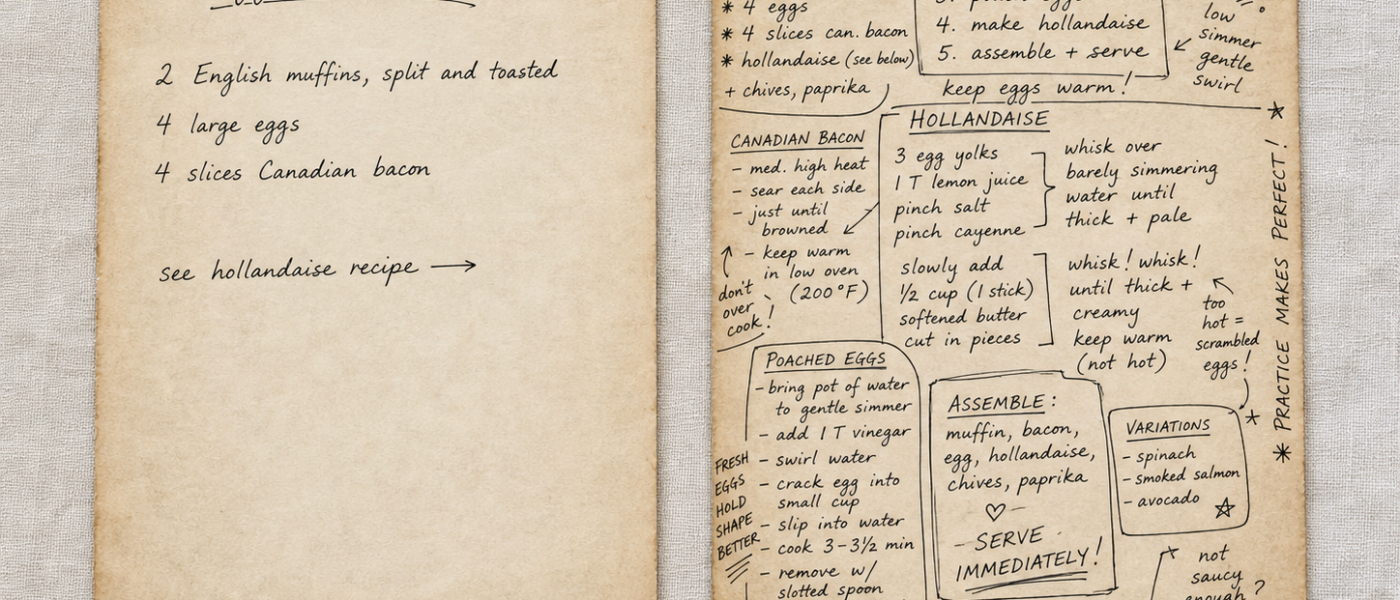
Picture a recipe card for eggs benedict. It tells you what the dish is, what goes into it, roughly how it comes together. At the bottom, where the hollandaise instructions would be, it says: “For the hollandaise, see our full sauce recipe.” And there’s a link.
Now picture a different version of that recipe card where the hollandaise instructions are written out in full. And the technique for perfectly poaching an egg. And a guide to choosing the right Canadian bacon. And a brief history of the dish’s origin at Delmonico’s in the 1860s.
Both pages are technically about eggs benedict. But they are doing completely different jobs, and only one of them does its job well.
This is the operating tension at the center of modern content strategy.
The Comprehensive Guide Problem
There’s a prevailing push toward what the industry calls “comprehensive guides,” one enormous page that covers everything about a topic. The intent is reasonable: demonstrate authority, capture long-tail queries, satisfy searcher intent in a single click.
The execution is usually a mess.
The bloated recipe card isn’t more useful. It’s harder to navigate, harder to cite, and harder for search engines to categorize precisely. A recipe for eggs benedict that contains a complete hollandaise tutorial also contains a complete poached egg tutorial also contains a guide to Canadian bacon. At that point, what is the page actually about? The relevance signal fractures.
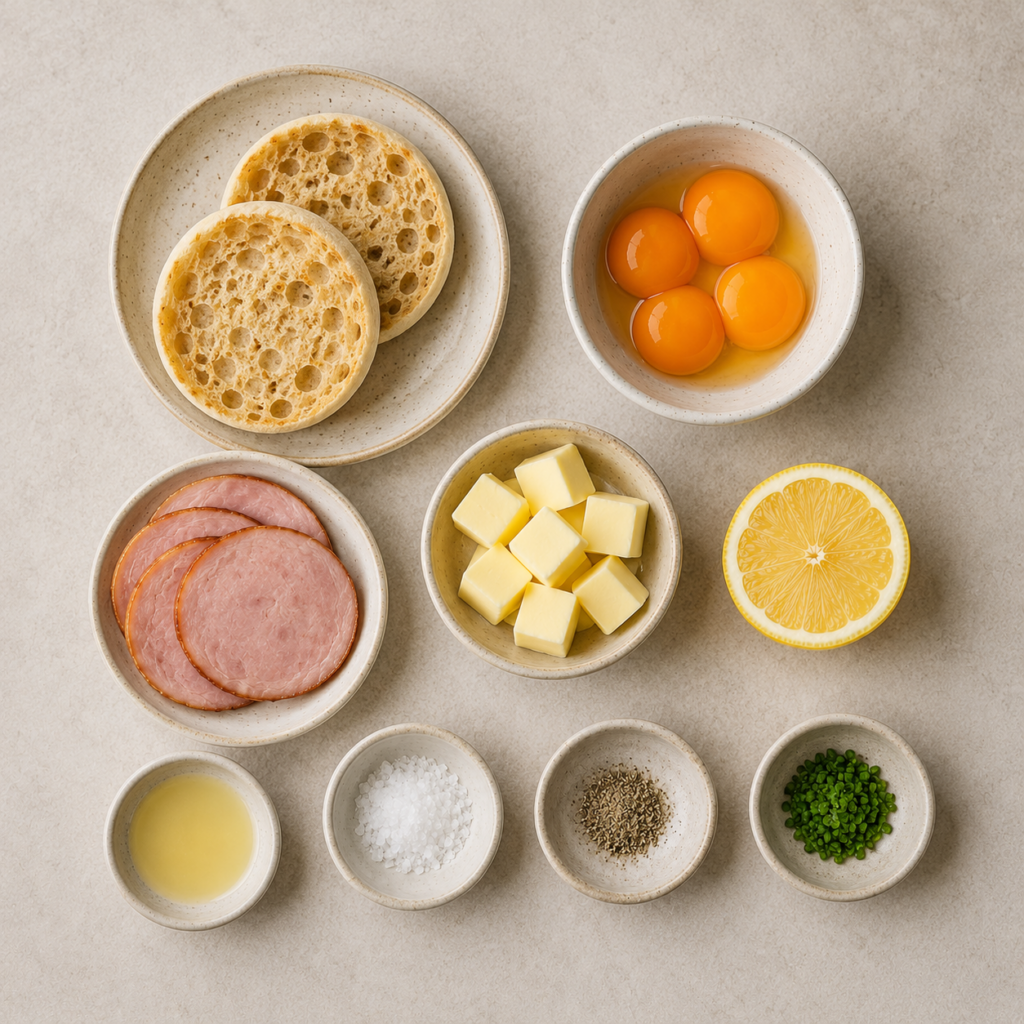
This is the comprehensive guide problem in practice. The page tries to be everything, and in doing so becomes harder to rank for anything in particular.
The Pillar Page as a Well-Scoped Recipe Card
The right version of the eggs benedict recipe card knows exactly what it is and what it isn’t.
It tells you:
– What the dish is and why it’s worth making
– What the four components are (the English muffin, the Canadian bacon, the poached egg, the hollandaise)
– Roughly how they come together
– Where to go for the full recipe for each component
That last part is the structural move most teams get wrong. The eggs benedict recipe card doesn’t need to contain the hollandaise recipe. It needs to reference it, describe it in enough detail to establish what it is, and link to where it lives in depth.
This is what a pillar page actually is: a well-scoped recipe card that orients the reader to the full recipe set and links out deliberately. It earns its authority by pointing, not by possessing.
The editorial rule that follows from this: if a section of your pillar page could stand alone as its own search query, it should have its own URL. The hollandaise section that runs 600 words isn’t enriching your eggs benedict page, it’s diluting it. Promote it to its own recipe card and link from the pillar.
The Risk: Authority Dilution by Expansion
Once this structure is in place, the temptation is to keep expanding the pillar. The hollandaise section seems thin. The poached egg explanation could use more detail. And before long, you’ve rebuilt the bloated recipe card through incremental additions rather than deliberate design.
The counterbalance is a clear editorial commitment: the pillar mentions, the cluster explains. Every section of the pillar page is a summary with a link out, not a standalone tutorial. The moment a section starts explaining rather than orienting, that content belongs elsewhere.
This also protects against topical dilution, a situation where the page becomes semantically ambiguous to both search engines and language models. A page that is specifically about eggs benedict, with clean internal links to hollandaise, poached eggs, and English muffins, sends a far clearer signal than a page that tries to be all of those things simultaneously.
The Entity Layer: Building a Knowledge Graph Around Your Content
Here’s where the strategy becomes structurally more interesting, and where optimization for LLMs separates itself from traditional SEO.
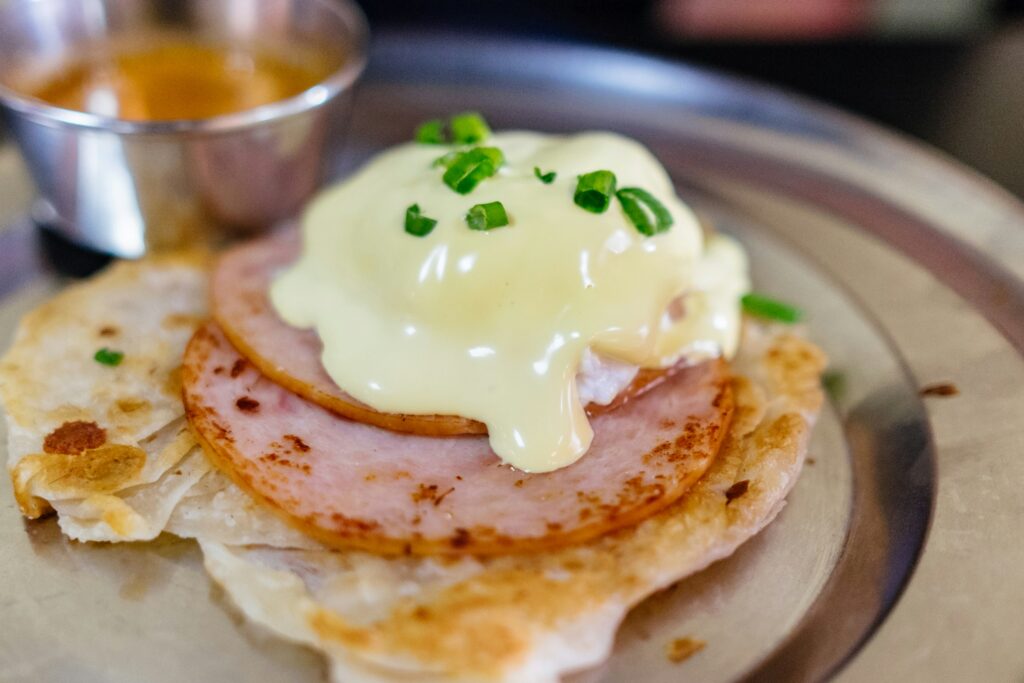
Hollandaise sauce isn’t just a subtopic. It’s an entity: a discrete, nameable thing with a defined set of relationships. Search engines have modeled this for years in their Knowledge Graph. Language models have internalized it during training. When either system encounters “hollandaise,” it’s resolving a node in a relationship network rather than keyword matching.
Your cluster page for hollandaise should reflect those relationships explicitly:
– Dishes it appears in: eggs benedict, asparagus with hollandaise, salmon hollandaise, steak hollandaise
– Category it belongs to: sauces → emulsion sauces → French mother sauces
– Ingredients it’s made from: egg yolks, clarified butter, lemon juice, white wine vinegar
– Technique it requires: double boiler, tempering, emulsification
When your content covers these nodes and links between them deliberately — a page for hollandaise, a page for emulsion sauces, a page for clarified butter technique, pages for the other dishes hollandaise appears in — you’ve built something neither a single mega-guide nor a pile of disconnected blog posts can achieve: a self-contained knowledge graph.
Every page is a node. Every internal link is a declared relationship. The structure as a whole is more navigable, more citable, and more authoritative than any individual page within it.

Why This Matters Differently for Search vs. LLMs
For search engines, the benefit is topical authority in its most precise form. A tight cluster of well-linked, semantically coherent pages signals domain expertise. Individual pages rank better because the whole structure reinforces each part.
For language models, the mechanism is subtly different and worth understanding on its own terms.
LLMs don’t index pages, they absorb content during training and synthesize from it during inference. When someone asks a model about hollandaise sauce, it constructs an answer from the clearest, most self-contained sources it encountered during training. A standalone recipe card that is specifically and only about hollandaise — with its ingredients, technique, category, and related dishes all clearly articulated — is far more likely to be synthesized and cited than the same information buried in paragraph 47 of a mega-guide.
This is what LLM citation gravity looks like in practice. The cleaner and more bounded your content, the more gravitational pull it has when a model is assembling an answer. Comprehensive guides are often too diffuse to be cleanly attributed. Focused cluster pages with explicit entity relationships are not.
The practical upshot: the same structural discipline that makes your pillar-and-cluster strategy perform better in search also makes it more visible in AI-generated responses. These aren’t two different strategies, they’re the same strategy, applied with the same rigor.

The Playbook
- Step 1: Scope the pillar to the recipe card, not the cookbook. The pillar defines the dish, names the components, links to the full recipes. That is its entire job.
- Step 2: Audit for implicit subtopics. Any section of the pillar that could stand alone as a search query gets promoted to its own URL. Use GSC and keyword research to validate which subtopics have independent demand.
- Step 3: Map entity relationships before writing. For each cluster page, explicitly document what the entity appears in, what category it belongs to, what it’s made of, and what technique or concept it requires. These relationships become your internal linking architecture and your heading structure.
- Step 4: Link deliberately in both directions. The pillar links down to each cluster page. Each cluster page links back up to the pillar and laterally to related entities: hollandaise links to eggs benedict, to asparagus hollandaise, to emulsion sauces. Every link is a declared relationship, not an afterthought.
- Step 5: Use structured data to formalize entity signals. Recipe schema, HowTo schema, and BreadcrumbList markup communicate entity relationships in machine-readable form.
- Step 6: Enforce scope discipline as an editorial rule. If a section of the pillar exceeds 300 words, it’s a candidate for its own page. Brainstorm a potential knowledge graph by listing various related topics and their categories. If it is sufficient in scope and topical relevance, the section can be moved to its own URL and expanded.
- Step 7: Measure topical authority across the cluster, not just the pillar. Track impression share for every entity in your cluster. If your hollandaise page starts picking up independent rankings, your knowledge graph is working.
The well-scoped recipe card doesn’t apologize for not containing the hollandaise tutorial. It’s confident in being exactly what it is, and it trusts that the full recipe set is available for anyone who wants to go deeper. That’s the posture your content should have too.